A material long associated with construction and industrial decline is re-emerging in an unexpected place: sand. From children’s play products to construction aggregates and natural environments, concerns are mounting over asbestos contamination in sand – and the risks are no longer confined to isolated consumer incidents.
A hidden hazard in plain sight
Asbestos is a naturally occurring group of fibrous minerals once widely used for its durability and resistance to heat. However, when disturbed, its microscopic fibers can become airborne and inhaled, posing serious health risks, including lung cancer, asbestosis and mesothelioma.
Recent developments have highlighted how easily asbestos can enter the sand supply chain. In early 2026, UK authorities issued new guidance on testing sand-containing products after concerns about contamination in items such as toys and decorative materials. A high-profile case earlier this year saw children’s play sand removed from sale after asbestos fibres were detected, reigniting public concern.
While such incidents may appear limited, experts warn they are symptomatic of a broader, systemic issue linked to global supply chains and inconsistent international standards.
Asbestos can pose hidden risks in homes, nurseries and schools, particularly where products containing sand or similar materials have been used over many years. Because asbestos fibers are microscopic and durable, they can remain undetected in certain manufactured or imported products long after installation or purchase. If these materials deteriorate, are disturbed during play, cleaning, or maintenance, or break down over time, they may release fibers into the air. Long-term, repeated exposure –even at low levels – can increase health risks, especially for young children whose lungs are still developing.
The challenge is that the presence of asbestos is often unknown, making proactive testing, clear supplier information and safe handling practices essential in environments where vulnerable individuals spend significant time.
Beyond products: an environmental concern
The danger of asbestos in sand extends far beyond consumer goods. Sand, soil and aggregates can become contaminated through natural geological deposits, historical industrial activity, or the improper disposal of asbestos-containing materials.
Environmental contamination is particularly concerning because it can transform entire sites into hazardous zones. Under UK law, land may be classified as “contaminated” if substances like asbestos pose a significant risk to human health or the environment.
|
|
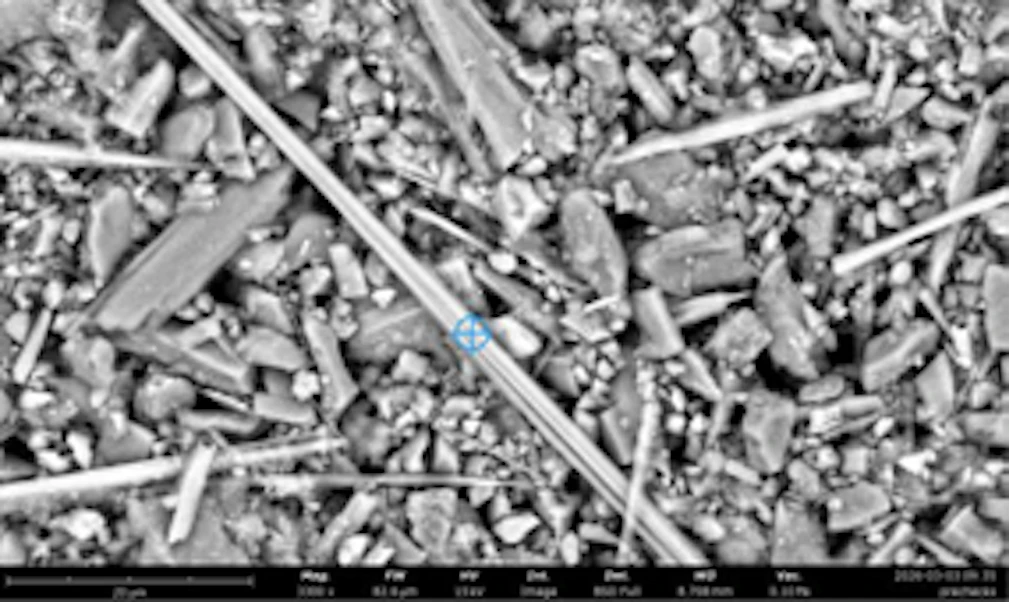
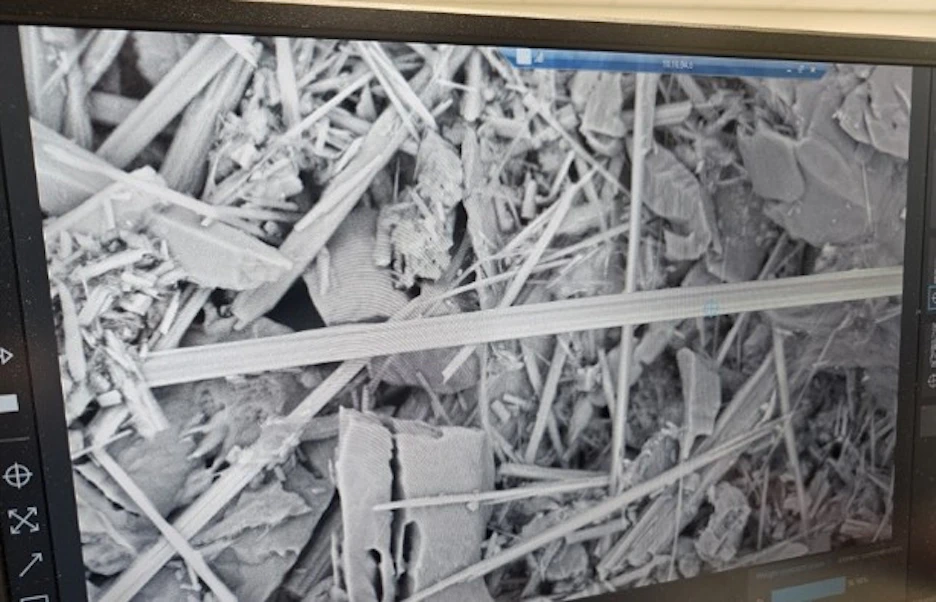
Fig 1. Needle-like Fibrous Tremolite asbestos in bundles of parallel fibers showing parallel splitting and high aspect ratios in play sand.
Fig 2. Fibrous Tremolite asbestos in high concentrations from inside a stretch-toy.
In such cases, everyday activities, such as construction, landscaping, or even natural erosion, can release fibers into the air. Unlike visible pollutants, asbestos fibers are microscopic and can remain undetected without specialized testing.
This creates a dual risk:
- Occupational exposure for workers handling contaminated materials
- Public health exposure in residential or recreational areas
Tightening regulation and the compliance challenge
The UK maintains a strict stance on asbestos. Legislation prohibits the sale of products containing asbestos fibers, reflecting its classification as a carcinogen. Additionally, the Control of Asbestos Regulations 2012 places legal duties on businesses to identify, assess and manage asbestos risks in workplaces and materials.
However, the emergence of asbestos in sand introduces new complexity. Unlike traditional asbestos-containing materials in buildings, contamination in granular materials like sand can be harder to detect and quantify, especially at very low concentrations.
Regulators now recommend advanced analytical techniques such as scanning electron microscopy (SEM) and transmission electron microscopy (TEM), capable of identifying even trace fibers below 0.1%.
For businesses operating in construction, manufacturing, landscaping, or retail, this raises a critical question: how can they ensure compliance when the risk is invisible?
The role of testing and verification
This is where we are playing a pivotal role. Through our comprehensive asbestos and fibers testing services, we help businesses identify, measure and manage asbestos risks across a wide range of materials, including sand, soil and aggregates.
Our services include:
- Laboratory analysis of sand, soil and bulk materials to detect asbestos fibers and determine their type and concentration
- Airborne fiber monitoring to assess exposure risks in active environments
- Pre- and post-remediation testing, ensuring sites are safe before redevelopment or reuse
- Asbestos surveys and risk assessments, supporting compliance with UK regulations
Beyond testing, we also assist organizations in developing asbestos management plans, auditing compliance and implementing control measures aligned with regulatory requirements
Navigating a complex risk landscape
As awareness grows, businesses are under increasing pressure to demonstrate due diligence to regulators, customers and stakeholders.
Failure to identify asbestos contamination can lead to:
- Legal penalties and fines
- Product recalls and reputational damage
- Long-term liability for health impacts
Conversely, proactive testing and risk management offer a pathway to compliance and confidence.
A problem still taking shape
The reappearance of asbestos risk in sand underscores a broader reality: legacy hazards do not remain confined to the past. As global supply chains evolve and environmental pressures increase, previously controlled risks can resurface in new and unexpected ways.
For regulators, businesses and the public alike, the challenge is clear: detect the invisible before it becomes irreversible.
And in that effort, rigorous testing and expert support may prove to be the most critical tools available.
Contact us
Rob Hinchcliffe
Hardlines Manager
Connectivity & Products
United Kingdom
t:+44 (0)151 350 6666
About SGS
SGS is the world’s leading Testing, Inspection and Certification company. We operate a network of over 2,500 laboratories and business facilities across 115 countries, supported by a team of over 100,000 dedicated professionals. With more than 145 years of service excellence, we combine the precision and accuracy that define Swiss companies to help organizations achieve the highest standards of quality, compliance and sustainability.
Our brand promise – when you need to be sure – underscores our commitment to trust, integrity and reliability, enabling businesses to thrive with confidence. We proudly deliver our expert services through the SGS name and a portfolio of trusted specialized brands, including Applied Technical Services, Brightsight, Bluesign and Nutrasource.
SGS is publicly traded on the SIX Swiss Exchange under the ticker symbol SGSN (ISIN CH1256740924, Reuters SGSN.S, Bloomberg SGSN SW).



Inward Way, Rossmore Business Park,
CH65 3EN,
Ellesmere Port, Cheshire, United Kingdom