By Johan Pype, Managing Director, SGS
Clinical research is evolving under pressure. Sponsors today face tighter timelines, higher financial pressure and a growing need to make decisions earlier in development. That shift is visible across biotech and pharma. The question is: how early you can generate the right insights to move forward with confidence.
We see this up close through daily interaction with our clients, while actively monitoring how the market is evolving. This continuous feedback loop helps us understand where friction occurs – where timelines slip, where complexity increases, where early clarity is missing. Those signals drive how we shape our organization. We adapt continuously, so our capabilities stay aligned with what the market and our clients actually need.
Rethinking speed: from timelines to earlier certainty
What has changed fundamentally is the expectation around timing, risk and evidence. Sponsors today operate under increasing pressure to generate meaningful data earlier, make faster decisions and adapt development pathways as new insights emerge. Biotech companies need early human data to secure funding. Pharmaceutical companies want to stop non-performing compounds sooner and focus investment where it matters. Speed alone is no longer sufficient. What matters is how quickly you reduce uncertainty.
That shift changes how studies are designed. Controlled Human Infection Models and early proof-of-concept studies help demonstrate efficacy sooner and with less risk, before scaling into larger trials. Hybrid designs, integrating healthy volunteers and patients within one clinical study when appropriate, also accelerate access to those early signals. Together, these models shorten the path from first-in-human to informed decision-making.
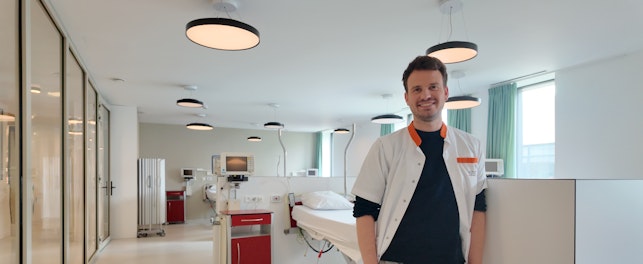
We have aligned our setup to support this. Our clinical pharmacology unit is designed with flexibility in mind. Through our collaboration with Antwerp University Hospital (UZA) and our extended patient site network, we connect early-phase research directly to patient populations. The objective is clear: generate reliable insights earlier, so decisions can follow with confidence.
Expanding Human Challenge trials where the market needs it
In the RSV space, we see a clear imbalance. As vaccine and antiviral programs move forward, sponsors want to understand the correlates of protection and efficacy sooner, yet access to suitable human challenge models has been limited. Available options have been scarce and largely concentrated outside Europe, leaving sponsors with little flexibility in how and where to run these studies. The need is not only for additional capacity, but for a more accessible and better integrated environment.
Belgium offers a strong answer to that need. As a recognized hub for biotech and pharmaceutical research, it brings together scientific expertise, clinical infrastructure and a more predictable regulatory environment with short standardized review timelines.
We have aligned our investments accordingly by bringing these elements together in a single location. Within the Antwerp CHIM hub, we have expanded our Controlled Human Infection Model capabilities with the development of an RSV-NICA challenge model. This builds on our existing portfolio in malaria, influenza H3N2 and rhinovirus, creating a broader and more flexible offering within one integrated European setting

Addressing structural constraints in ADME
ADME may receive less attention, but it continues to play a decisive role in early development and regulatory submission. Yet across Europe, the number of clinical sites equipped to conduct ADME trials has declined significantly. Only a limited number remain. The gap sits in available capacity, the accreditations and in the level of expertise required to manage these complex studies and the sample analysis. As a result, sponsors face limited choice and increasing pressure on timelines when planning these studies, creating a structural bottleneck.
At the same time, approaches such as microdosing support faster and lower-risk decisions, aligning with the broader need to generate actionable insights earlier in development.
We have chosen to respond to that need by bringing ADME and microdosing back into our portfolio, building on existing experience in Belgium.
Centralizing biometrics for faster, more consistent decisions
As development timelines compress, the role of biometrics becomes more critical. Sponsors rely on fast, consistent data to make decisions, yet in many organizations, biometrics remains fragmented across locations and teams. This often leads to slower turnaround times, inconsistent approaches and longer decision cycles.
We see a clear need in the market for a more centralized and agile model. One where expertise is concentrated, processes are aligned and communication flows without delay.
We have structured our biometrics services accordingly. By centralizing our teams in a dedicated cluster in Mechelen, we bring scale and consistency together in one location. This allows us to standardize processes, share expertise more effectively and ensure alignment across studies. At the same time, our lean organizational setup enables faster decision-making.
Without layers of international escalation, we respond more quickly to client needs and adapt as studies evolve. This combination of scale and agility allows us to deliver both efficiency and flexibility in supporting sponsors.

Data consistency as a strategic priority
Data plays a central role in all of this. Yet inconsistencies between tools and interpretations have often created inefficiencies.
The introduction of CDISC Open Rules is an important step forward and represents a fundamental shift toward machine-executable standards, reducing ambiguity and aligning validation across stakeholders. It allows for more consistent and transparent data validation. We are actively involved in this evolution: contributing directly to the development of these rules and ensuring that these standards reflect real operational needs.
In parallel, we have established an internal cross-functional taskforce to explore how AI can responsibly accelerate clinical development. AI has clear potential, but clinical research is not consumer technology. Validation, safeguards and human oversight remain essential. The focus is not on following hype, but on strengthening clinical integrity while enabling faster, more reliable insights.
Positioned for what comes next
Across all these areas, one principle stands out. Our strategic choices are guided by continuous dialogue with sponsors, ensuring that capabilities evolve in line with real needs. The ability to listen, adapt and integrate is what allows us to remain relevant in a landscape where expectations continue to shift.


Zone portuaire Lomé, Route d’Aného,
Entrée Campus STSL-Baguida, BP 3626,
Lome,
Togo