In today’s unpredictable world, organizations in the Middle East face a growing range of disruptions. This ranges from regional geopolitical tensions and supply chain interruptions to sandstorms, floods, pandemics and large-scale IT outages.
Business leaders can no longer rely on ad hoc reactions when a crisis hits; they must build structured resilience into the way they operate. ISO 22301, the international standard for Business Continuity Management Systems (BCMS), offers a clear and practical framework to do exactly that.
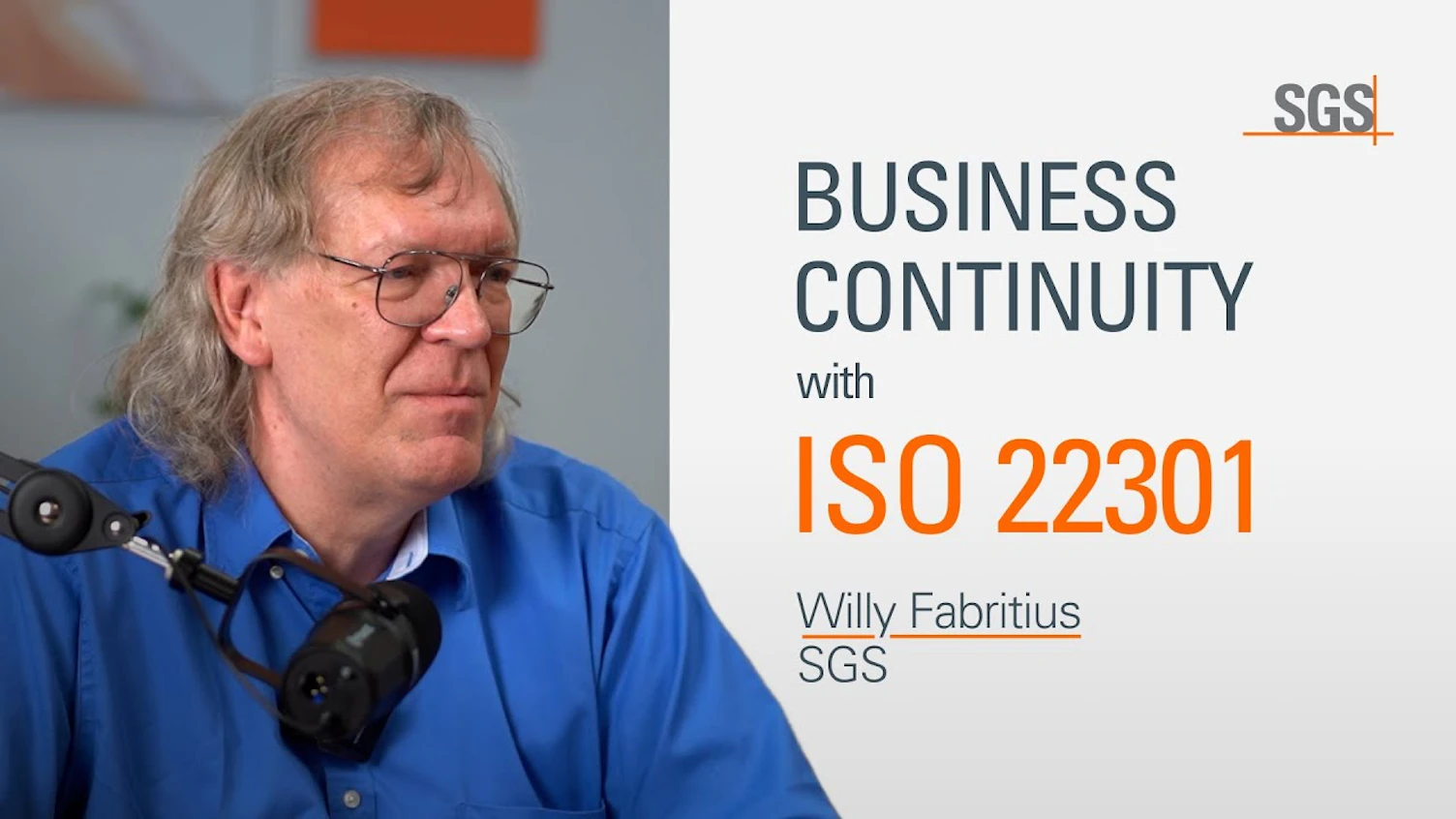
This article covers the main themes and practical insights shared by Willy Fabritius, Global Head of Strategy and Business Development, Business Assurance, at SGS, in his video where he explains what business continuity really means, how ISO 22301 supports it and how organizations in the Middle East can implement a Business Continuity Management System step by step.
You can watch the complete video from here.
What business continuity really is (and is not)
Business continuity is not a new idea. For decades, companies have been asking themselves “what if something goes wrong?” and trying to prepare for disruptions. What has changed over the last 25–30 years is that this thinking has become more structured and disciplined, and this global best practice has been captured in ISO 22301.
A common misunderstanding, especially in highly digital organizations, is that business continuity is the same as IT continuity. Ensuring that networks, applications and data centers remain available is important, but it is only one part of the picture. Business continuity looks at the entire business and asks: what are the critical activities we must protect and how do we keep them running when the unexpected happens?
Consider a testing or inspection company operating laboratories, such as those found across the Middle East. Of course, stable IT networks and internet connectivity are essential to manage test data, client communication and reporting. But what if the laboratory building itself is unavailable due to fire, flooding or structural damage? What if a bus drivers’ strike prevents staff from reaching the facility? What if a sandstorm or flood keeps people at home, or a pandemic like COVID-19 restricts movement entirely? These events are not IT incidents, yet they can stop operations just as effectively.
A robust BCMS ensures that the organization can continue delivering essential services, even when the disruption is physical, logistical, or health-related rather than purely digital.
How BCMS complements traditional risk management
Most organizations in the region already have established risk management practices in place covering areas such as finance and health and safety and HR and compliance and operational risk. These approaches play a critical role in identifying risks assessing likelihood and impact and defining controls to reduce exposure.
A Business Continuity Management System builds on this foundation. While risk management focuses on prevention and mitigation BCMS focuses on organizational resilience and response. It addresses a different but closely related question: how will the organization continue to operate if a major disruption occurs despite existing controls?
Traditional risk assessments often consider individual scenarios such as floods fires cyber incidents or supply chain disruptions. BCMS takes a capability based view recognizing that different incidents can lead to the same operational consequences. These may include facilities becoming unavailable transportation routes being disrupted critical suppliers failing to deliver employees being unable to work on site or IT systems being unavailable.
By focusing on these shared impacts BCMS helps organizations design response and recovery arrangements that remain effective regardless of the specific cause of the disruption.
Business continuity management asks:
- Which activities are critical to our survival and to our customers?
- What are the maximum acceptable downtimes?
- What resources (people, facilities, suppliers, IT, logistics) are essential?
- If these resources are lost, how do we recover them within the required timeframe?
By focusing on consequences rather than specific incident types, a BCMS makes planning much more practical and scalable, especially in a region like the Middle East, where natural, political and economic factors can change rapidly.
Why business continuity and ISO 22301 matter in the Middle East
Customers, regulators and business partners in the Middle East increasingly expect uninterrupted service. The days when an organization could tell its customers, “our warehouse burned down, come back in three months,” are over. Clients expect you to deliver products and services when you promise to deliver them, regardless of internal disruptions. The same applies to banks, utilities, transport providers and critical infrastructure: people expect access now, not at some uncertain point in the future.
ISO 22301 certification demonstrates that an organization has a structured, independently assessed system in place to manage business continuity. It shows that the company is not relying on informal, ad hoc reactions but on defined processes, responsibilities and tested plans.
This can be a significant competitive advantage in the Middle East, where many sectors – such as oil and gas, logistics, financial services, healthcare and government services are under increasing pressure to prove resilience and reliability.
A strong BCMS supported by ISO 22301 provides assurance to:
- Customers, who want confidence that you will deliver even in a crisis.
- Regulators and government bodies, who increasingly emphasize resilience.
- Shareholders and investors, who are concerned about long-term continuity and reputation.
- Employees, who want clarity on what will happen and what is expected of them in a disruption.
- Suppliers and partners, who rely on stable operations across the value chain.
Ultimately, a well-implemented BCMS prepares the organization for the “unthinkable”, the sudden “oops” moment when something major goes wrong, and turns that preparedness into measurable trust and market advantage.
Core components of an effective BCMS
Implementing, maintaining, and operating a BCMS requires both the right structure and the right skills. At its heart, an effective BCMS revolves around understanding what could go wrong and defining realistic recovery timeframes for critical activities. These timeframes should be driven primarily by customer expectations, contractual obligations and regulatory requirements, not just by internal convenience.
Key components include:
- Business impact analysis (BIA): Identifying critical processes, dependencies and the impact of downtime on customers and stakeholders.
- Risk and scenario analysis: Understanding which types of events could threaten those processes and what their consequences would be.
- Recovery strategies: Defining how to restore operations; for example, alternative sites, remote working arrangements, backup suppliers or manual workarounds.
- Documented plans and procedures: Clear, accessible continuity and recovery plans that specify who does what, when and how.
- Competence and training: Ensuring that key individuals have the necessary knowledge and skills, through internal experience or formal training and certification.
- Testing and exercises: Regularly rehearsing scenarios to validate plans and build confidence.
- Monitoring, review, and continual improvement: Learning from tests, incidents and audits to strengthen the BCMS over time.
For organizations in the Middle East, investing in training, whether through internal programs or external academies, is critical. Business continuity is a specialized field; sending staff to targeted courses helps build internal competence so the BCMS is not just a paper exercise but a living, practical system that people understand and can apply in real situations.
Common mistakes to avoid when implementing a BCMS
Many organizations struggle with the same set of issues when they attempt to implement ISO 22301. Being aware of these pitfalls from the start can save time, cost and frustration.
The most frequent problems include:
- Lack of management commitment: If top management simply says “go ahead and do it” but does not actively support the program, allocate resources or communicate its importance, the BCMS will not be effective. Business continuity must be visible as a management priority, not just an operational project.
- Insufficient resources: Implementing a BCMS requires time, people and sometimes investment in alternative facilities, IT solutions or training. Underestimating this leads to incomplete or ineffective implementation.
- Treating business continuity as an IT-only project: Focusing only on data backup, DR sites and network resilience misses the broader picture. If the BCMS does not cover people, facilities, supply chain and critical manual processes, it is not a true BCMS.
- Overcomplicating scenarios: Getting lost in long lists of detailed incident types instead of focusing on consequences and impact can overload teams and slow decision-making.
- Implementing once and then “freezing” the system: A BCMS must be continually improved. If internal audits, exercises and management reviews do not lead to visible improvements, it signals weak commitment and will be a concern in external assessments.
By addressing these issues early, organizations in the Middle East can build a BCMS that not only meets ISO 22301 requirements but also genuinely supports resilience and business growth.
Roadmap for implementing ISO 22301 in your organization
Implementing a BCMS according to ISO 22301 follows a logical, repeatable path similar to other management systems (such as ISO 9001 for quality or ISO 14001 for environment). For organizations in the Middle East, the following roadmap offers a practical starting point:
- Understand business impact and benefits
- Define why business continuity matters for your organization, markets, regulators and key customers in the region.
- Conduct a high-level business impact analysis to identify critical services and activities and to clarify how long they can be disrupted before causing unacceptable damage.
- Build internal competence
- Identify key people who will drive the BCMS (continuity manager, process owners, IT, HR, facilities, etc.).
- Provide them with targeted training and, where appropriate, professional certifications so they fully understand ISO 22301 requirements and best practices.
- Design and implement the BCMS
- Align your policies, objectives, roles and responsibilities with ISO 22301.
- Perform detailed business impact analyses and risk assessments for critical processes.
- Define recovery strategies and document continuity and recovery plans covering people, premises, technology, data, suppliers and logistics.
- Ensure integration with existing management systems (quality, information security, environment) to avoid duplication.
- Operate, test and refine
- Run awareness sessions and exercises so staff understand their roles in a disruption.
- Conduct internal audits to verify that the BCMS is implemented and effective.
- Use test outcomes, incident reviews and feedback to improve procedures, communication and technical measures.
- Prepare for certification
- Optionally, perform a gap assessment to identify remaining weaknesses.
- Undergo a stage 1 audit, where auditors review documentation and confirm that the system is sufficiently implemented.
- Follow with a stage 2 “on-site” audit, where auditors test how the BCMS works in practice across functions and locations.
- Address any nonconformities identified during audits; once closed, you can receive the ISO 22301 certificate.
- Maintain, monitor, and continually improve
- The certificate is typically valid for three years, with annual surveillance audits to confirm that the BCMS remains active and effective.
- At the end of the cycle, a recertification audit verifies that the system still meets requirements and reflects changes in your business, technology, and regional risk landscape.
- Continual improvement should be visible year after year, signaling strong leadership commitment and a genuine resilience culture.
Turning continuity into a strategic advantage
For organizations across the Middle East, business continuity is no longer a “nice to have” or merely a compliance exercise. It is a strategic capability that directly influences customer trust, regulatory confidence and long-term competitiveness. ISO 22301 provides a proven, globally recognized framework to build this capability in a structured way.
By understanding that business continuity goes beyond IT, securing strong management support, investing in skills and following a clear implementation roadmap, organizations in the region can build BCMSs that protect their people, operations and reputation – and position themselves as reliable partners in an uncertain world.
Stay informed. Subscribe now.
For exclusive insights on management systems, ISO standards and sustainable business growth, subscribe to our monthly email newsletter.

About SGS
SGS is the world’s leading Testing, Inspection and Certification company. We operate a network of over 2,500 laboratories and business facilities across 115 countries, supported by a team of over 100,000 dedicated professionals. With more than 145 years of service excellence, we combine the precision and accuracy that define Swiss companies to help organizations achieve the highest standards of quality, compliance and sustainability.
Our brand promise – when you need to be sure – underscores our commitment to trust, integrity and reliability, enabling businesses to thrive with confidence. We proudly deliver our expert services through the SGS name and a portfolio of trusted specialized brands, including Applied Technical Services, Brightsight, Bluesign and Nutrasource.
SGS is publicly traded on the SIX Swiss Exchange under the ticker symbol SGSN (ISIN CH1256740924, Reuters SGSN.S, Bloomberg SGSN SW).