Saudi Arabia, a nation at the forefront of medical advancements in the Middle East, has established a robust regulatory framework to ensure the safety, performance and effectiveness of medical devices entering its market.
Medical Device Manufacturers, established inside or outside Saudi Arabia, and their distributors seeking to expand their reach into Saudi Arabian market, to provide the society a legitimate access to State-of-the-Art medical devices, can utilize this guidance in understanding and adhering to the regulations in force.
This guide, written by Syed Atheeq, Lead Auditor and Product Manager for Medical Devices, SGS Saudi Arabia, delves into the intricacies of registering and marketing medical devices in Saudi Arabia, empowering manufacturers and their supply chain partners to navigate the regulatory landscape with confidence.
Medical Device Regulation in Saudi Arabia
The Saudi Food and Drug Authority (SFDA) enforces stringent regulations for medical device that includes product registration, importation, storage, transportation, marketing and post marketing activities, closely aligned with international regulations such as EU's MDR and IVDR.
Despite this alignment, having a CE marking does not substitute for SFDA’s requirements. Manufacturers and their distributors must comply with comprehensive requirements, including specific documentation and studies, to market their devices in Saudi Arabia.
Classification of Medical Devices in KSA
The medical devices regulatory framework has a classification system for medical devices as per the classification rules specified in SAFDA Requirements for Medical Devices Marketing Authorization MDS-REQ1. The manufacturer is responsible for determining the classification of a device using a set of classification rules in it.
General Requirements for Registering a Medical Device in Saudi Arabia
The registration process for medical devices varies between local manufacturers and those based outside Saudi Arabia.
- The local manufacturers can initiate the medical device registration via SAFDA Online Portal.
- Medical device manufacturers based outside Saudi Arabia shall first appoint an Authorized Representative by signing a mandate defining the roles and responsibilities undertaken by both parties in the supply chain of the medical devices.
Thereafter, the Authorized Representative shall perform the product registration on behalf of the manufacturer. Nevertheless, if the manufacturer does not wish to share the confidential technical documentation of product with the appointed Authorized Representative, SFDA provides an option for the foreign manufacturer to submit the product registration documentation directly to SFDA via an online portal.
It is important to note that the manufacturer and its authorized representative, must implement and obtain a Quality Management System Certification as per ISO 13485:2016. Such certification must be obtained from SFDA-accredited certification body or IAF accredited certification body.
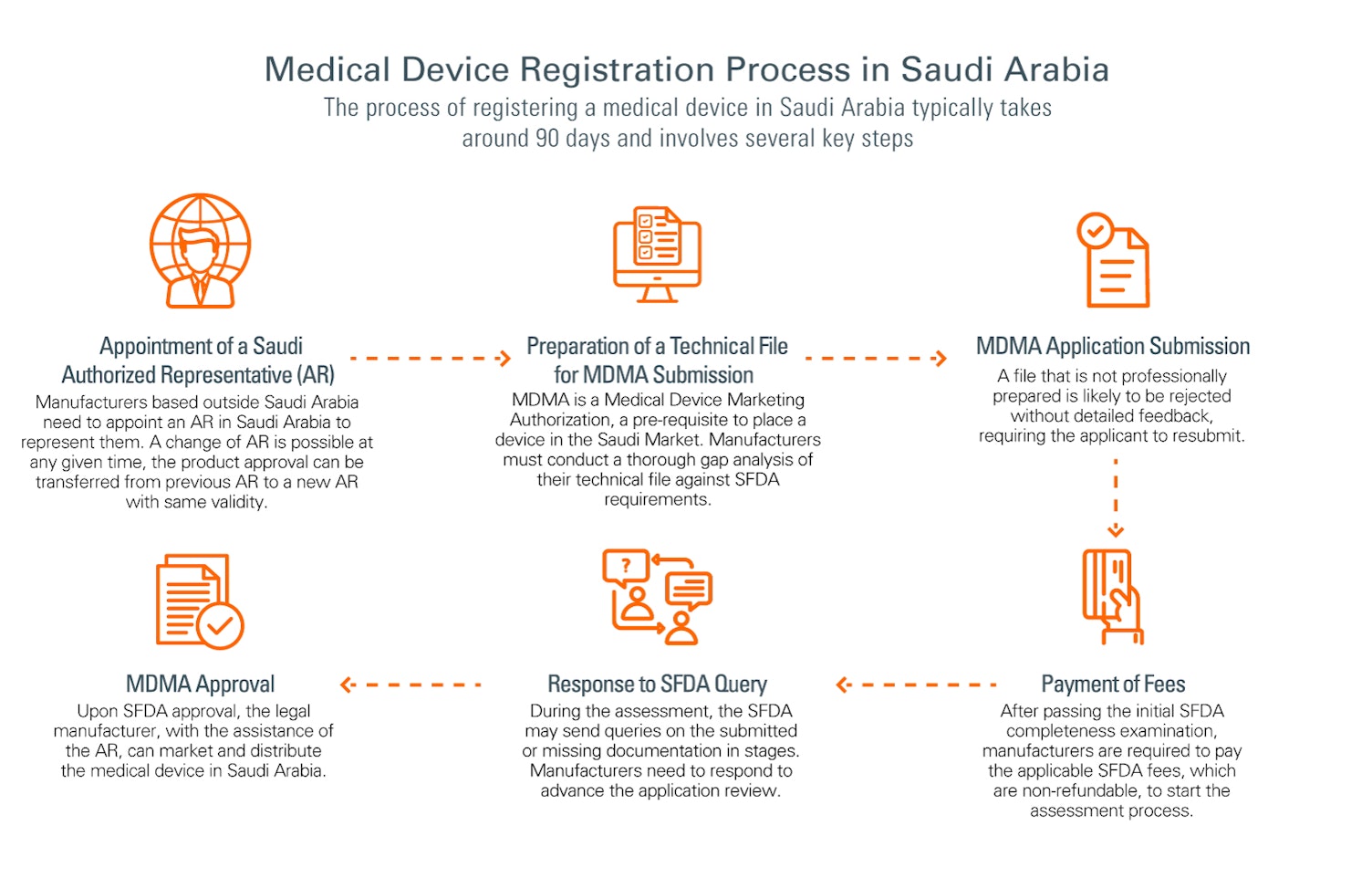
This streamlined process ensures that medical devices entering the Saudi market meet all necessary safety and quality standards set by the SFDA.
SGS Solutions for the Medical Devices Sector in Saudi Arabia
In Saudi Arabia, SGS provides certification and training solutions for the medical devices sector, delivered by local experts proficient in both English and Arabic. Through SGS Academy in Saudi Arabia, we offer specialized classroom and virtual training programs to ensure compliance with international standards and regulatory requirements.
ISO 13485 Certification – Medical Devices Quality Management Systems
ISO 13485 is a globally recognized standard and minimum requirement for medical device manufacturers and is fundamental to numerous international market access programs, such as the Medical Device Single Audit Program (MDSAP), CE, and UKCA marks.
SGS can assist in achieving ISO 13485:2016 compliance by demonstrating that stakeholder meet regulatory requirements in the following areas:
- Management responsibility: Ensuring leadership and commitment to quality management.
- Resource management: Efficiently managing resources to maintain quality.
- Product realization: Overseeing the processes from design to delivery.
- Measurement, analysis, and improvement: Continuously monitoring and improving processes.
Read our latest article about ISO 13485 Certification in Saudi Arabia.
MDR Certification in Kingdom of Saudi Arabia KSA
SGS provides expert support to help medical devices manufacturers in Saudi Arabia understand and comply with the Medical Device Regulation (MDR) requirements.
Our internationally recognized training courses and certification services ensure that products meet the stringent MDR standards, enabling manufacturers to obtain the CE mark for EU market access.

About SGS
We are SGS – the world’s leading testing, inspection and certification company. We are recognized as the global benchmark for sustainability, quality and integrity. Our 99,600 employees operate a network of 2,600 offices and laboratories around the world.