When a workplace incident occurs, the most dangerous response is to stop at the obvious answer. A worker falls from scaffolding and the investigation concludes: 'worker did not wear a harness.' A chemical exposure occurs and the finding is: 'worker failed to follow procedure.' These surface-level conclusions feel satisfying, but they miss the point entirely. They place blame on individuals rather than fixing the systems that failed those individuals.
Two of the most powerful tools in the root cause analysis (RCA) toolkit, the 5 Whys technique and the Fishbone (Ishikawa) Diagram, exist precisely to break this pattern.
Used correctly within an ISO 45001 incident management framework, they push investigators to dig below the surface and uncover the organizational, cultural and systemic failures that create the conditions for incidents. In the context of today's Middle East; a region navigating significant economic transformation, workforce transitions, supply chain pressures, and shifting regulatory landscapes, these tools are more relevant than ever.
The 5 Whys: Simple, Powerful, Often Misused
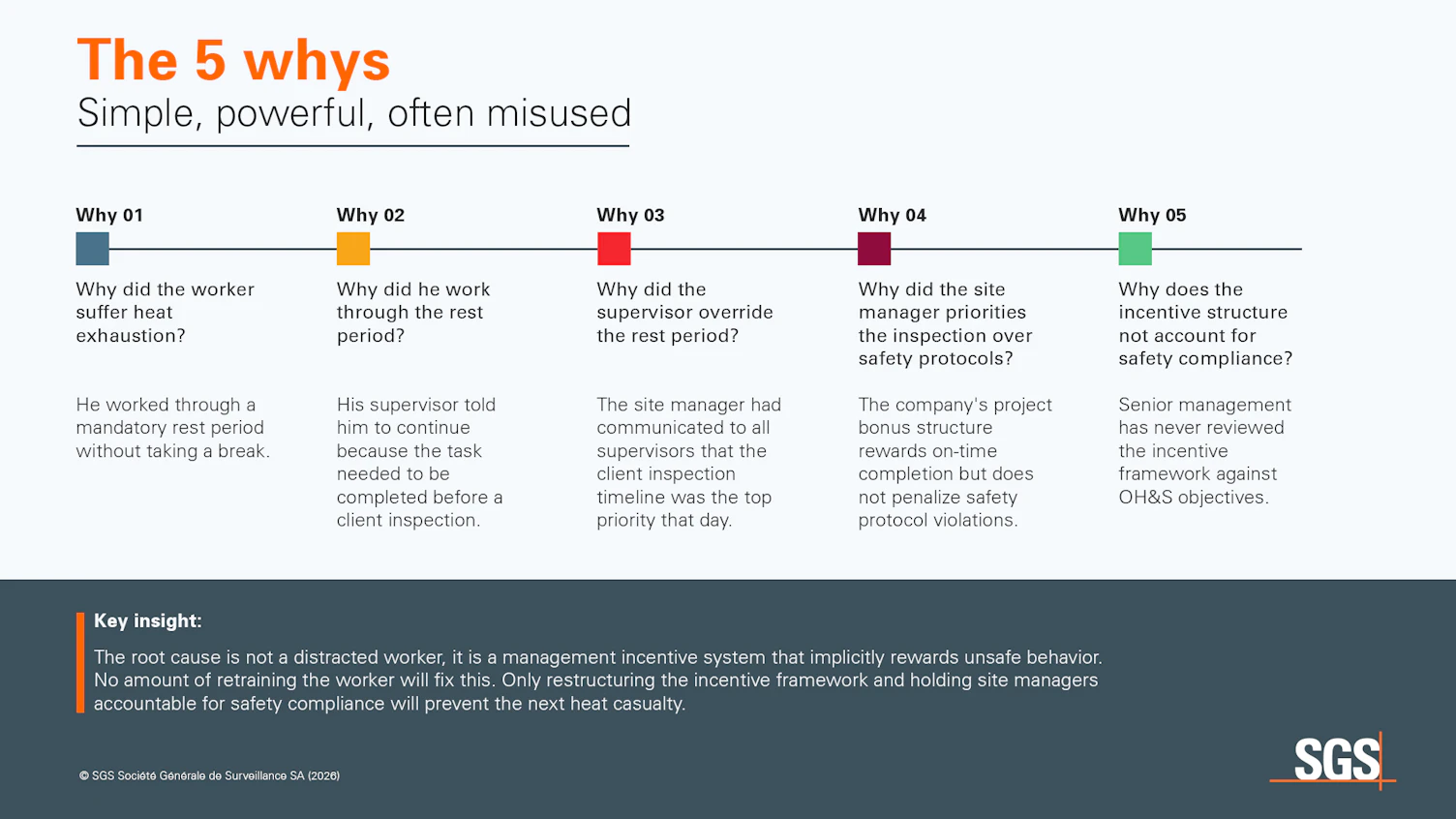
Developed by Sakichi Toyoda and popularized through the Toyota Production System, the 5 Whys technique is elegantly straightforward: when an incident or problem occurs, ask 'Why did this happen?' then ask 'Why?' again to the answer, and again, and again until you reach a root cause. Five iterations is a rule of thumb, not a hard rule; some investigations need three, others need seven.
Consider a construction site in the Gulf region where a worker suffers heat exhaustion on a summer afternoon.
The Fishbone (Ishikawa) Diagram: Mapping Complexity
While the 5 Whys works best for incidents with a relatively linear causal chain, many workplace incidents in complex industrial environments have multiple contributing factors across different domains. This is where the Fishbone Diagram, also known as the Cause-and-Effect or Ishikawa Diagram, becomes indispensable.
The diagram takes its name from its shape: a horizontal arrow (the 'spine') pointing to the incident or problem (the 'head'), with diagonal branches (the 'bones') representing major categories of potential causes. Traditional categories include the '6 Ms': Man, Machine, Method, Material, Measurement, and Milieu (Environment). Teams brainstorm causes within each category and map them visually, revealing the full landscape of contributing factors.
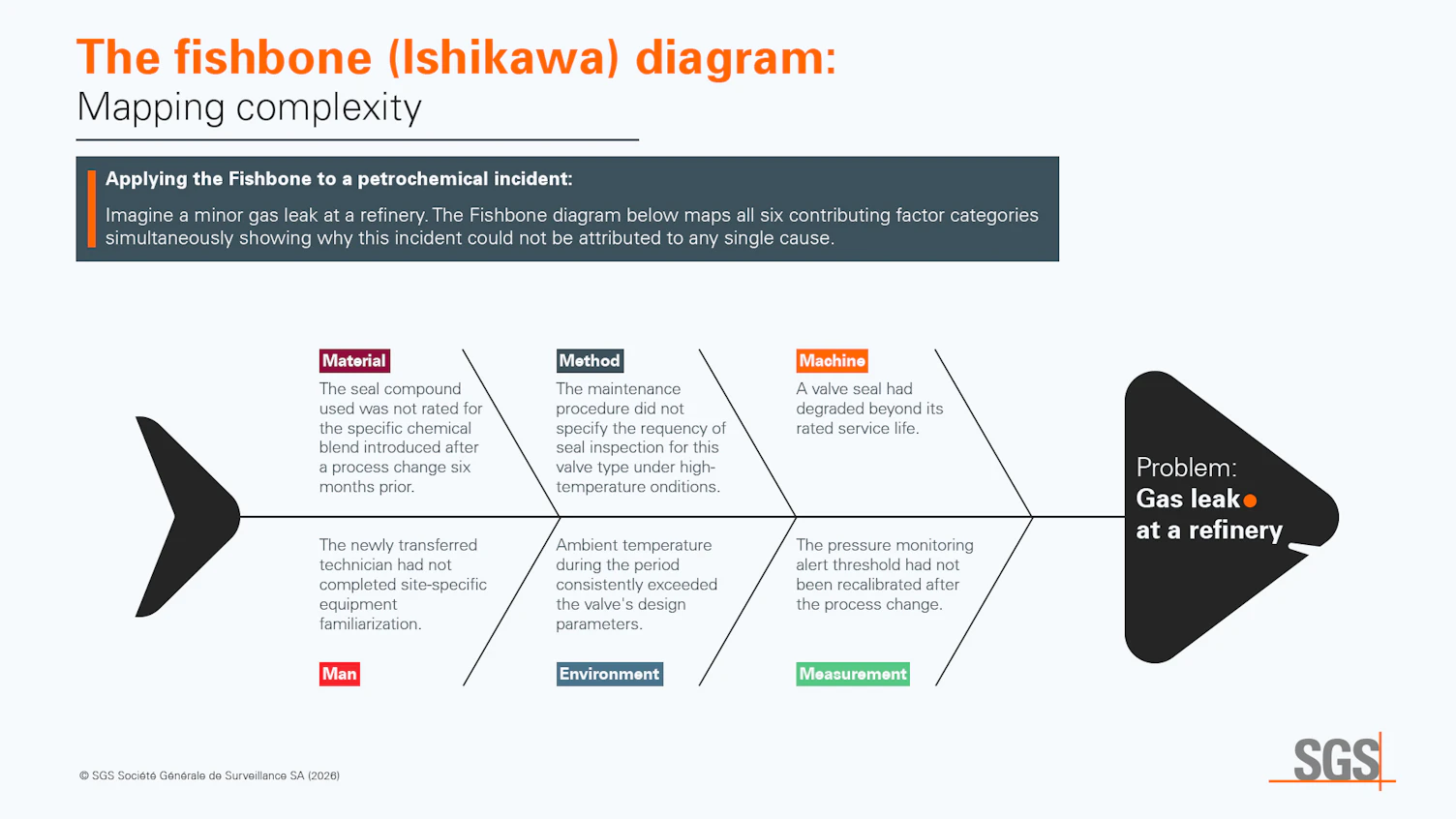
No single branch tells the full story. The leak required the simultaneous presence of several contributing factors; a degraded seal, an outdated procedure, an incompatible material, extreme heat, an untrained technician and a mis calibrated alarm. Addressing only one factor leaves the system vulnerable to a repeat event through a different combination. The Fishbone diagram makes this multi-causal reality visible to the investigation team and to senior management.
The Fishbone in Today's Middle East Context
The Middle East's current operational environment is characterized by rapid workforce change, significant technology adoption, and evolving supply chains, all of which create new branches on the Fishbone.
The large-scale deployment of migrant workers means that training gaps, language barriers and unfamiliarity with local procedures regularly feature under the 'Man' branch. The fast-tracking of mega-projects means that process changes (new materials, new equipment) are often introduced faster than maintenance procedures and training materials can be updated; a recurring theme in the 'Method' and 'Material' branches.
The Fishbone diagram provides a structured way to capture all of these dynamics in a single visual analysis.
5 Whys vs. Fishbone: Choosing the Right Tool
Both tools are valuable, but neither is sufficient on its own. Their effectiveness depends on how they are applied and the complexity of the incident.
A practical approach is to begin with a Fishbone Diagram to systematically explore all possible contributing factors across categories such as people, process, equipment, environment, and management systems. This helps avoid early bias and ensures broader coverage.
Once key contributing factors are identified, the 5 Whys technique can be applied selectively to the most critical branches to investigate causal depth and uncover underlying system failures.
This combined approach balances exploration and validation, reducing the risk of jumping to conclusions or stopping too early.
As a general guide:
- Use the 5 Whys for relatively contained issues where the causal chain is observable and evidence is available
- Use the Fishbone Diagram when multiple variables, teams, or systems are involved
- Use both together for high-risk or high-impact incidents where both completeness and depth are required
Comparison Table
| Aspect | 5 Whys | Fishbone Diagram |
| Primary Purpose | Identify underlying cause through sequential questioning | Explore and structure multiple contributing factors |
| Best suited for | Simple to moderately complex incidents with traceable cause-effect relationships | Complex incidents involving multiple variables or departments |
| Analytical focus | Depth of causation | Breadth of contributing factors |
| Output | Causal chain, may lead to one or several root causes | Visual framework of categorized contributing factors |
| Strength | Simplicity, quick to apply, promotes deeper thinking | Structured brainstorming, reduces risk of missing factors |
| Limitation | Can oversimplify, depends heavily on facilitator skill, risk of linear bias | Does not validate causality, can become superficial if not followed by deeper analysis |
| When to use | When evidence supports a clear sequence of events | When causes are unclear, distributed, or cross-functional |
| Typical use case | failures, single-event incidents | System failures, recurring issues, cross-functional breakdowns |
| Combined use | Applied after Fishbone to validate key branches | Used first to map potential causes before deeper analysis |
Why These Tools Matter More Than Ever in Today's Middle East
The Middle East is at an inflection point. Mega-projects are being delivered at unprecedented scale and speed. NEOM, Diriyah, Expo City Dubai and dozens of infrastructure programmes across the GCC. These projects are employing hundreds of thousands of workers, often under intense delivery pressure and in extreme environmental conditions. At the same time, regional governments are scrutinizing workplace safety more closely than ever, with Qatar's labor reforms following intense international attention and Saudi Arabia's Vision 2030 explicitly linking economic ambition with improved social and welfare standards.
In this environment, incident investigation tools that identify systemic failures, not individual scapegoats, are not just good safety practice. They are a business imperative. Every major incident that makes international headlines carries reputational, legal and financial consequences that can dwarf the cost of the safety investments that would have prevented it. The 5 Whys and the Fishbone diagram, embedded in a mature ISO 45001 system, provide the means to learn from every near-miss before it becomes a tragedy.
Conclusion
Root cause analysis is where safety management systems earn their value.
The 5 Whys and Fishbone Diagram are not complicated, or expensive tools require no specialist software, no large budgets and no external consultants. What they do require is leadership commitment to honest inquiry, a culture where workers feel safe to provide candid input and the discipline to follow findings through to systemic corrective action.
For Middle East businesses operating in one of the world's most dynamic and demanding environments, these are investments that pay back many times over in safer workers, stronger operations and organizations built to last.
Stay informed. Subscribe now.
For exclusive insights on management systems, ISO standards and sustainable business growth, subscribe to our monthly email newsletter.

About SGS
SGS is the world’s leading Testing, Inspection and Certification company. We operate a network of over 2,500 laboratories and business facilities across 115 countries, supported by a team of over 100,000 dedicated professionals. With more than 145 years of service excellence, we combine the precision and accuracy that define Swiss companies to help organizations achieve the highest standards of quality, compliance and sustainability.
Our brand promise – when you need to be sure – underscores our commitment to trust, integrity and reliability, enabling businesses to thrive with confidence. We proudly deliver our expert services through the SGS name and a portfolio of trusted specialized brands, including Applied Technical Services, Brightsight, Bluesign and Nutrasource.
SGS is publicly traded on the SIX Swiss Exchange under the ticker symbol SGSN (ISIN CH1256740924, Reuters SGSN.S, Bloomberg SGSN SW).




Office 11, Ahmadi Center, Building 100, Block 7, East Ahmadi,
61008,
Al Ahmadi, Kuwait