Exchangers, boilers and fan coolers having carbon steel tubes, create a challenge for inspection due to nature of material properties and excessive corrosion present on tubes surface. This affects inspection results. Therefore, an appropriate inspection package needs to be developed to overcome these problems.
Considering these challenges, the most appropriate solutions for carbon steel tube inspection are Remote Filed Testing (RFT) and Internal Rotary Inspection System (IRIS). These techniques not only give desired results but also have the added advantage of keeping the project cost at the lower end. Let’s look at these techniques in detail.
Inspection strategy
In this inspection strategy, which was created especially for carbon steel tubes, all tubes are first scanned using the Remote Filed Testing (RFT) technique, which serves as a screening method. Defective tubes are highlighted during this screening.
After an initial screening of all tubes with RFT an execution of a second scan will be carried out only on those tubes that would be highlighted in RFT inspection. This gives us the added benefit of accurate defect sizing and geometry information while also addressing the RFT’s limitation of being unable to differentiate between inside (ID) and outside (OD) defects.
Remote Field Testing (RFT) working principle
The RFT is a through-wall transmission technique where the magnetic field travel through the tube wall twice, once at the exciter location and once at the receiver location. Any defect located at the exciter and/or receiver location will have an impact on the magnetic field read by the coils. The measurement corresponds to the total material thickness that the magnetic field has gone through.
For this reason, the RFT technique cannot differentiate between ID or OD, the coils only measure the total thickness of material.
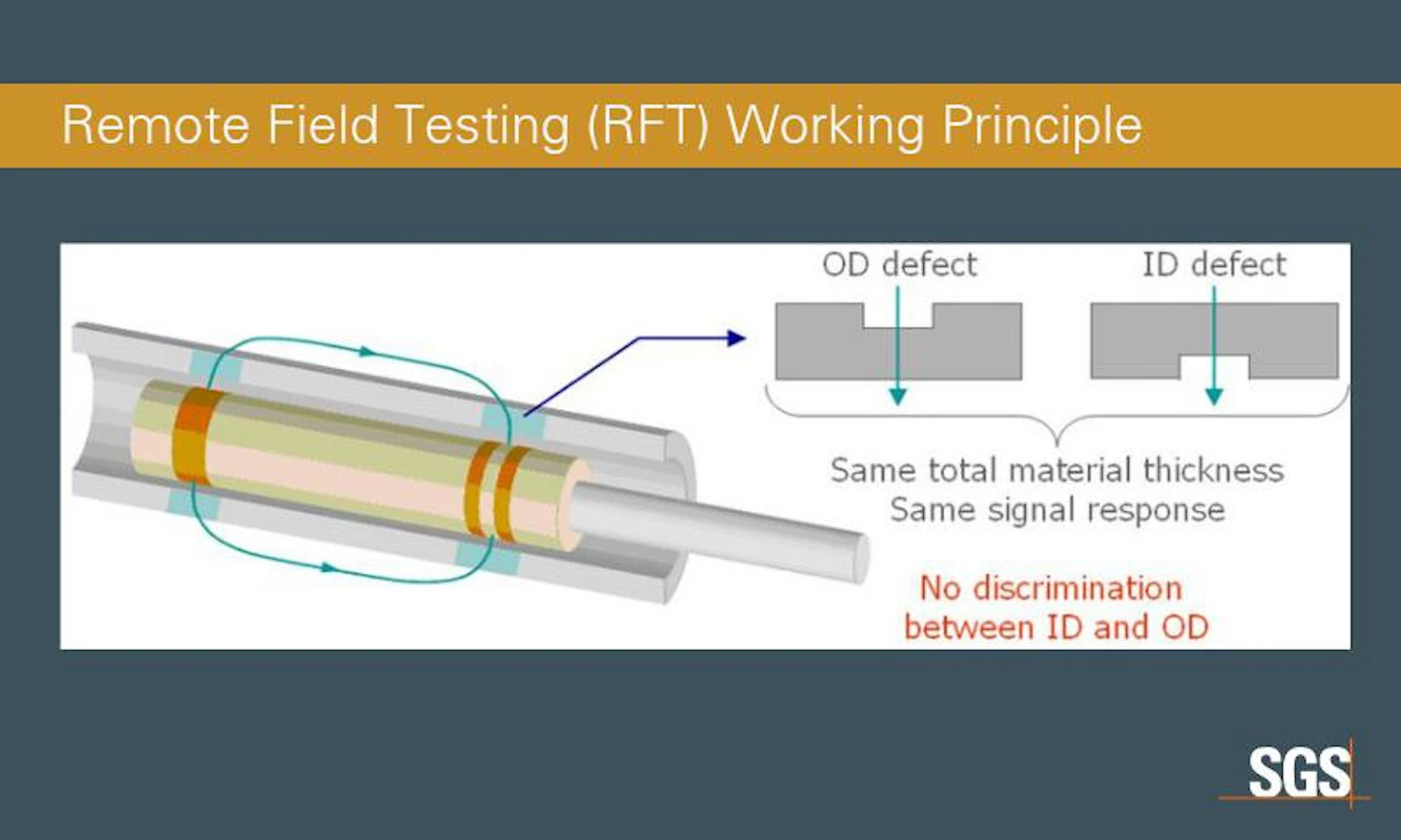
In other words, they are placed at a distance where they are unaffected by the magnetic field from the exciter coil but can still adequately measure the field strength from the secondary magnetic field.
By monitoring the consistency of the voltage induced in the pick-up coils one can monitor changes in the test specimen. The strength of the magnetic field at this distance from the excitation coil is weak but it is sensitive to changes in the pipe wall from the ID to the OD.
IRIS working principle
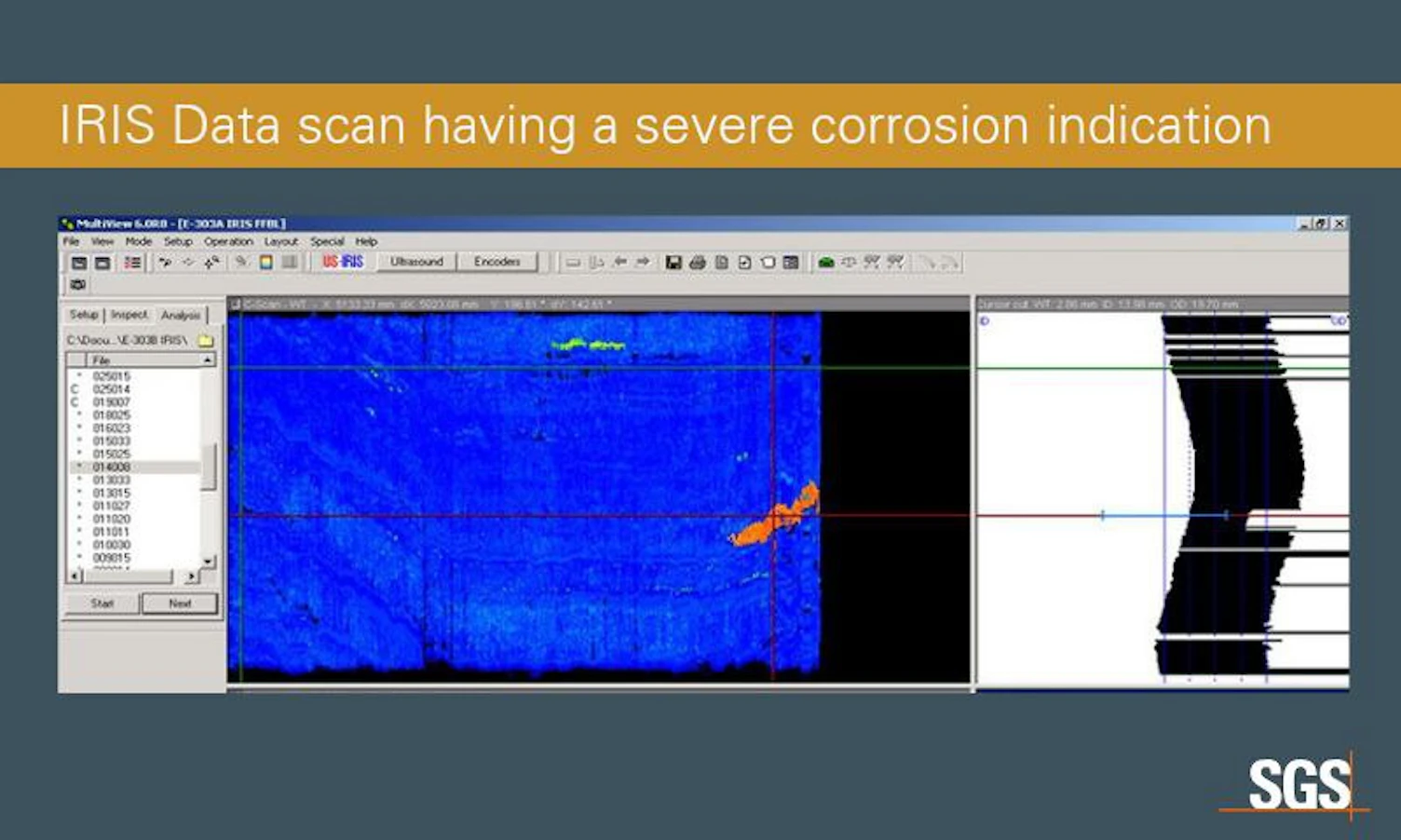
Internal Rotary Inspection System (IRIS) works on the pulse-echo principle similar to most of ultrasonic testing techniques. IRIS probe consists of a turbine (a rotating device) and a cable having wires to carry signals. The tube is filled with water by flooding. The ultrasonic pulses are generated by the transducer within the probe and transmitted along a path parallel to the tube axis. These pulses are then redirected radically to the tube wall with the help of 45º rotating mirror. The mirror is rotating with the help of pressurized water passing through the probe cable.
This mirror distributes the ultrasonic beam around the tube circumference. The ultrasonic beam is reflected from tube ID and OD, the time between these two signals represents tube thickness. The same process is repeated (in reverse order) to receive the return signal. These signals are shown on the equipment screen as B, D & C scans after processing by equipment.
Conclusion
The SGS inspection methodology for carbon steel tube inspection not only successfully addresses the inspection-related difficulties, but also offers the additional benefit of keeping the project’s overall cost at a manageable level.
About SGS
We are SGS – the world's leading testing, inspection and certification company. We are recognized as the global benchmark for sustainability, quality and integrity. Our 99,600 employees operate a network of 2,600 offices and laboratories, working together to enable a better, safer and more interconnected world.


Office 11, Ahmadi Center, Building 100, Block 7, East Ahmadi,
61008,
Al Ahmadi, Kuwait