Ceramic tile products, including porcelain, are regulated by the Saudi Standards, Metrology and Quality Organization (SASO) under the Technical Regulation for Building Materials – Part 4: Bricks, Tiles, Ceramics, Sanitary Ware and Related Products. They are required to obtain the Saudi Quality Mark (SQM) to enter Saudi ports or be sold on Saudi markets.
With a market for imported ceramic tile products worth USD 2.37 billion by the end of June 2024 according to the Saudi Customs Authority, the SQM mandate of September 13, 2019, requires traders to conform to the ISO/IEC 17065 international quality standard.
During the SQM conformity assessment process, ceramic tile grouts and adhesives are reviewed against specific standards and requirements. Classifications, characteristics and markings are also evaluated against international standards and SASO regulations.
What is the Saudi Quality Mark?
The SQM is a prestigious quality mark granted by SASO. It indicates that an effective management system is in place which complies with the standards and technical regulations of the Kingdom of Saudi Arabia.
The Quality Mark represents the highest level of conformity assessment and compliance according to the international standard ISO/IEC 17067, for which SASO designed the licensing service in accordance with the requirements of the international standard ISO/IEC 17065. Validity of the SQM lasts for three years.
Benefits of obtaining the SQM
Market access
- The SQM increases the marketing exposure within the Kingdom of Saudi Arabia and other Gulf regions
- Products holding the SQM mark have the advantage of obtaining SABER product and shipment certificates of conformity, free of charge
Consumer trust
- The SQM logo enhances consumer trust
Competitiveness
- Products that have the SQM are differentiated from other products
Product recognition
- Products with the SQM are recognized in local, regional and global markets
Ceramic tile products
The SQM certification scheme includes all different types of ceramic tiles; glazed or unglazed, exterior or interior, flooring or cladding; whether they are manufactured through pressing or extrusion, and with all different levels of water absorption capacities.
Who can apply?
All manufacturers, distributors, importers and exporters of ceramic tile products.
Steps to acquiring the SQM
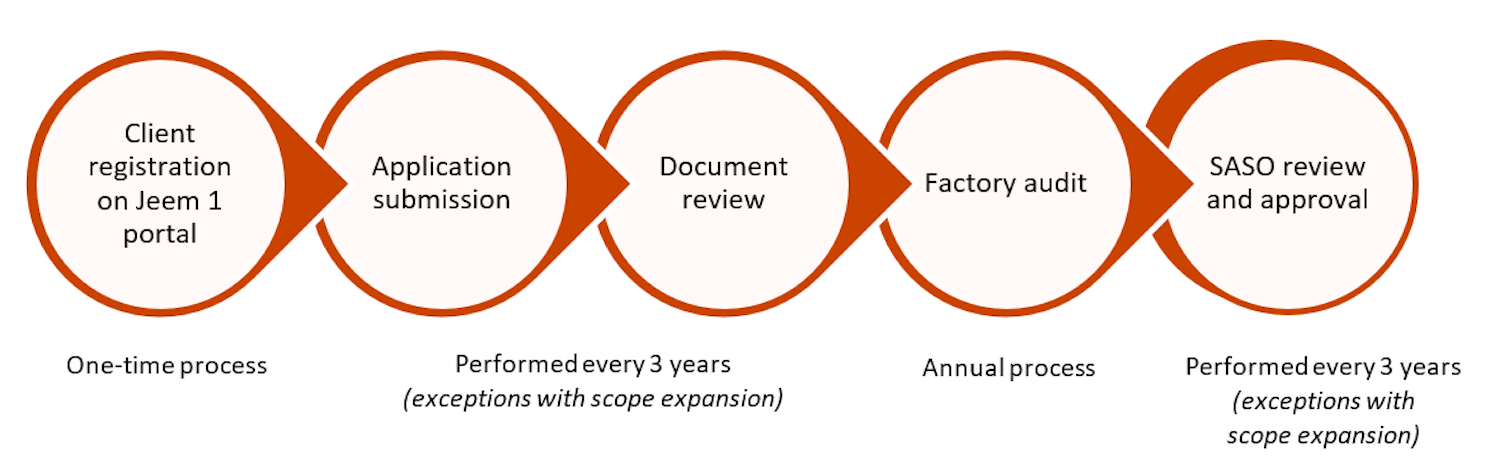
Documents required to obtain the SQM
After the SQM applicant creates an account on the Jeem1 portal, the following documents must be provided:
- Valid industrial license
- Valid commercial registration of the establishment
- Proposal with SGS
- Test reports from SASO approved labs/other ISO/IEC 17025 accredited labs
- ISO/IEC 17025 accreditation certificate and scope of the testing laboratory
- Instruction manual in English and Arabic, where applicable
- Rating label/product marking labels and photos
- Accreditation certifications (ISO 9001, ISO 14001, ISO 22000 etc.), if available
- QMS factory manual
- Factory quality control plan
- Factory location map
- Organizational structure of the establishment
The application documents for the SQM must be submitted in English and Arabic. If this is not available in English and Arabic, a sworn translation of the document in either language should be submitted.
We have successfully helped many ceramic tile factories globally to obtain the SQM, specifically from high-exporting countries of ceramic tile products such as Spain, Italy, China and India. Our technical experts and experienced auditors hold the highest educational, training, and professional experience in the ceramic industry.
At SGS, we proudly support our clients in accessing Saudi markets, help them with the local conformity requirements, and assist them in obtaining and maintaining their SQM licenses for ceramic tile products.
Learn more about Saudi Arabia – SQM.
This article can also be found in our PCA Newsletter (Q3/2024) – which keeps you up to date with developments in technical barriers to trade and product conformity assessment.
Read more PCA articles (Q3/2024)
- How the Ivory Coast Import Market is Changing
- Marking Three Years of PCA Services in Morocco
- Export Your Goods With East to South Sudan
You can read more articles in our previous editions in the PCA Newsletter Library.
© SGS Société Générale de Surveillance SA.