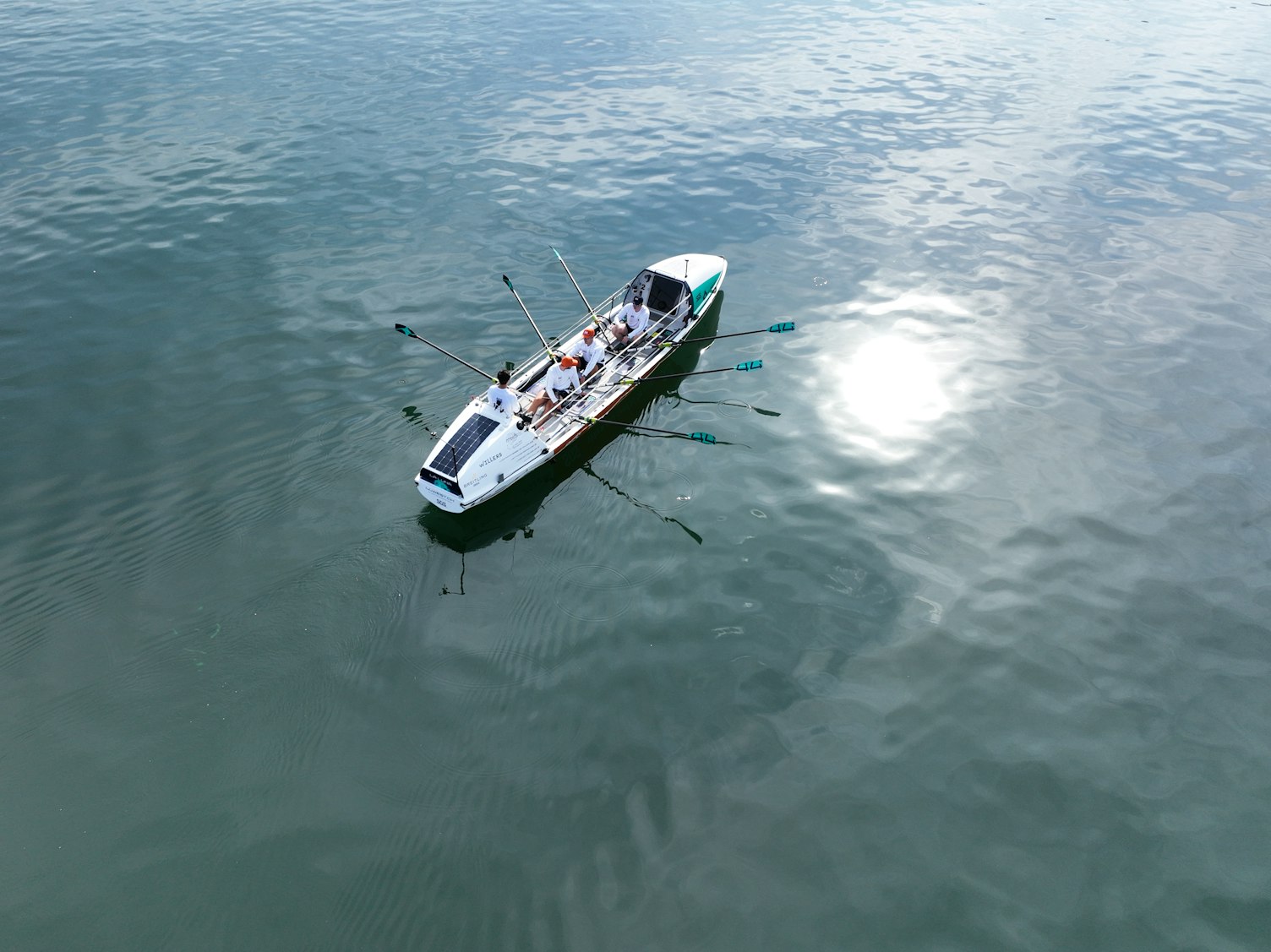
As the 44west team prepared for one of the world’s toughest rowing races across the Atlantic, SGS tested a critical piece of equipment used during the crossing – the Starlink Mini, which supports communications and navigation throughout the race.

Reliable onboard connectivity is essential for both performance and safety. Equipment used at sea is exposed to one of the harshest environments on the planet. Saltwater spray, saturated humidity, temperature fluctuations and mechanical impacts all accelerate corrosion, often far faster than in land-based conditions.
For connected devices, corrosion can lead to degraded performance, intermittent connectivity, component damage and failure – and during an ocean race, failure can be critical, as external assistance may not be available. Corrosion can also be intensified by mechanical stress, which may crack protective coatings and create micro-leaks that allow moisture intrusion.
Which tests did SGS carry out for the 44west team?
Products are rarely used under ideal conditions. Environmental simulation testing allows real-world exposure – including corrosion, humidity and temperature variation – to be reproduced in a controlled laboratory environment.
At SGS, corrosion testing follows a structured approach:
- The sample is assessed in its initial condition
- It is then aged in a test chamber under controlled exposure
- The sample is reassessed multiple times throughout the test and evaluated at the end
This process helps identify weaknesses such as unsuitable materials, insufficient surface treatments, poor sealing, vulnerable assemblies and galvanic incompatibility – all of which can compromise long-term reliability in marine conditions.
At our CESTAS laboratory in France, we carried out a 504-hour corrosion test on the Starlink Mini, in accordance with ISO 9227. The test involved exposure to:
- 5% salt spray
- 35°C
- A deposition rate of 1 to 2 milliliters per hour per 80 cm2
By reproducing extreme marine exposure in the laboratory, the test provides objective insight into how the equipment may perform during the Atlantic crossing.
Our results
At the end of the test period, the Starlink Mini showed:
- Slight oxidation on the crimping ring at the base
- Light red corrosion on the socket
- More significant deterioration on the hex key, including extensive red corrosion from salt spray
These findings help confirm how the device components respond under prolonged salt-spray exposure, supporting reliability assessment for real-world offshore conditions.
Customer Service & Labs Director, France
Environmental simulation testing allows real-world conditions to be reproduced in the laboratory, helping us anticipate their impact on product lifespan and reliability.
Supporting durability and sustainability
Durability and sustainability are closely linked, particularly in demanding environments. Corrosion testing helps manufacturers identify weaknesses early and improve design choices such as material selection, coatings and sealing methods.
By supporting long-term resistance to salt, humidity and cyclic climate stress, this approach helps extend product lifespan, reduce premature failure, limit maintenance and replacement needs, and lower overall environmental impact across the product life cycle.
SGS’s wider testing services
Beyond this project, we provide comprehensive testing and qualification services for materials, components and complete systems across multiple industries. As an independent technical partner, we support organizations by validating performance, durability and compliance using internationally recognized methodologies, including ISO, EN and IEC standards.
These services help companies reduce safety and reliability risks, strengthen product quality and accelerate time to market through objective testing under realistic and controlled conditions.



Units 303 & 305, 3/F, Building 22E,
Phase 3, Hong Kong Science Park,
Pak Shek Kok, New Territories, Hong Kong, China