The Forum for Exchange of Information on Enforcement (Forum) is a network of authorities responsible for the enforcement of the REACH, CLP, PIC, POP, and Biocidal Product regulations in the EU, Norway, Iceland, and Liechtenstein with the aim to improve the protection of human health and the environment from the risks that can be posed by chemicals while enhancing the competitiveness of the EU chemicals industry.
In December 2023, they published the first edition of the REF-10 project report regarding the integrated control of chemicals in products (substances, mixtures, and articles) within different legislation such as the REACH Regulation (Regulation (EC) No. 1907/2006), POP Regulation (Regulation (EU) No 2019/1021), RoHS Directive (Directive 2011/65/EU) and Toys Directive (Directive 2009/48/EU). The only part excluded from "restrictions" is the REACH legislation concerning candidate list substances (Article 33).
In this report, it shows that over 2,400 products were checked in 26 EU countries, more than 400 of them had breached various chemicals laws.
- Electrical devices such as electrical toys, chargers, cables, and headphones: 52 % of these products were found non-compliant, mostly due to lead found in solders, phthalates in soft plastic parts, or cadmium in circuit boards
- Sports equipment such as yoga mats, bicycle gloves, balls, or rubber handles of sports equipment: 18 % of these products were found to be non-compliant mostly due to SCCPs and phthalates in soft plastic and PAH in rubber
- Toys such as bathing/aquatic toys, dolls, costumes, play mats, plastic figures, fidget toys, outdoor toys, slime, and childcare articles: 16 % of non-electric toys were found to be non-compliant, mostly due to phthalates found in soft plastic parts, but also other restricted substances such as PAHs, nickel, boron or nitrosamines
- Fashion products such as bags, jewelry, belts, shoes, and clothes: 15 % of these products were found non-compliant due to the phthalates, lead, and cadmium
In cases where non-compliant products were found, inspectors have taken enforcement measures, with most of them resulting in the withdrawal of such products from the market.
To avoid such action, SGS Green Mark, Hazardous Substance Assessed (HSA), can precisely verify the presence of, and to quantify the volume of, >300 hazardous substances of environmental concern which may be harmful to humans and the environment. This includes heavy metals, persistent organic pollutants, and others. This assessment covers hazards that may occur throughout a product.
The aim is to improve transparency and enable differentiation in competitive markets while allowing consumers access to better information to drive their decision-making process, whether that’s concerns over cybersecurity, environmental protection or performance.
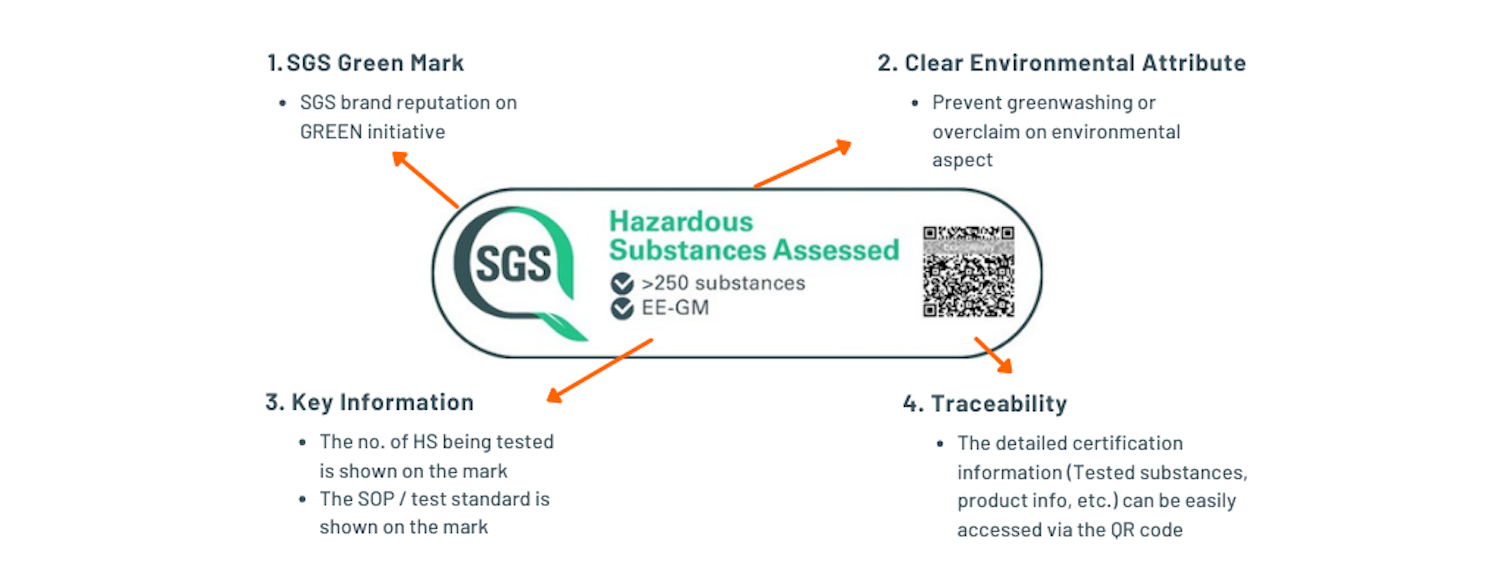
SGS Green Mark, alongside the SGS Performance Mark, SGS Food Contact Product Mark and SGS Cybersecurity Mark, we can support manufacturers, suppliers and retailers in the delivery of safe, high-performing and compliant products to target markets.
For enquiries, please contact our Customer Service team for details!
To obtain a copy in PDF, please click here.
About SGS
We are SGS – the world’s leading testing, inspection and certification company. We are recognized as the global benchmark for sustainability, quality and integrity. Our 99,600 employees operate a network of 2,600 offices and laboratories around the world.
Units 303 & 305, 3/F, Building 22E,
Phase 3, Hong Kong Science Park,
Pak Shek Kok, New Territories, Hong Kong, China